Home/Training
◆HVAC Academy · Training
HVAC Academy — the course that replaces guesswork with calculation
Five modules, from the heat-loss calculation to boiler room controls. Every module ends with a spreadsheet you fill in with your own project.
Ask us by phone about the format, the next dates and the fee.
Heating system · schematic diagramcircuit running
01Boiler02Low-loss header03Radiator pump04Radiators05Underfloor mixing unit06Underfloor pump07Underfloor heating08Expansion vessel
Who it is for
three roles, one reason01Installers
To stop repeating the layout from the last job and start calculating. A calculation settles most of the arguments on site before they start.
02Designers
Hydraulics, balancing and boiler room schemes at the level of working solutions rather than a textbook, with a look at what actually gets built.
03Sales and supply teams
To speak the installer’s language: to understand what is being selected and why, and not to offer a boiler where the question is about another component.
Programme
five modulesModule 1 — Heat loss8
- How to measure the building envelope
- Thermal calculation
- Indoor and outdoor design conditions
- Additional heat-loss coefficients
- Coefficients for insulating elements
- Reducing heat loss through insulation
- Practical work: heat loss for a 350 m² house
- Calculation spreadsheet
Module 2 — Radiator systems9
- Types of radiator
- Rules for mounting radiators
- Real output of radiators, convectors and fan coils
- Radiator circuit hydraulics: pipe diameters and pumps
- Running the radiators of every floor from one pump
- Manifold (star) radiator layout
- Setting radiator valves correctly
- Connecting radiators and convectors to room thermostats and phone control
- Calculation spreadsheet
Module 3 — Underfloor heating8
- Rules for laying underfloor heating
- Floor surface temperature requirements
- Sizing underfloor output in HERZ CO
- Underfloor hydraulics: pipe diameters and pumps
- Distributing output room by room and adding radiators where it falls short
- Running the whole house underfloor system from one pump
- Connecting to room thermostats and phone control
- Calculation spreadsheet
Module 4 — The boiler room8
- Expansion vessel for the heating system
- Low-loss header
- Primary-secondary loop
- Balancing the heating system
- Boiler room schematic
- Alternative boiler room schemes
- Boiler room controls: weather compensation, phone control, 20–50% savings
- Calculation spreadsheet
Module 5 — Advanced topics7
- Heat pumps: selection, integration, installation and start-up
- Systems with a solid fuel boiler
- Water supply
- Pressure booster pumps
- Sizing a cylinder
- Pool water heating
- Automatic irrigation with Hunter
What you will learn to read and calculate
the schematic is on the first screen, the hardware is in the hallThe schematic above is a boiler room drawn the way one is actually built on site. It is live: the modes change by themselves, temperatures are recalculated, the pumps turn.
In module four we take it apart node by node: why the low-loss header is there, where the expansion vessel sits, how the underfloor mixing is calculated, and why the boiler short-cycles when the circuits are not decoupled.
After the course you will not only read a schematic like this but draw one for your own project — with diameters, flow rates and valve settings.
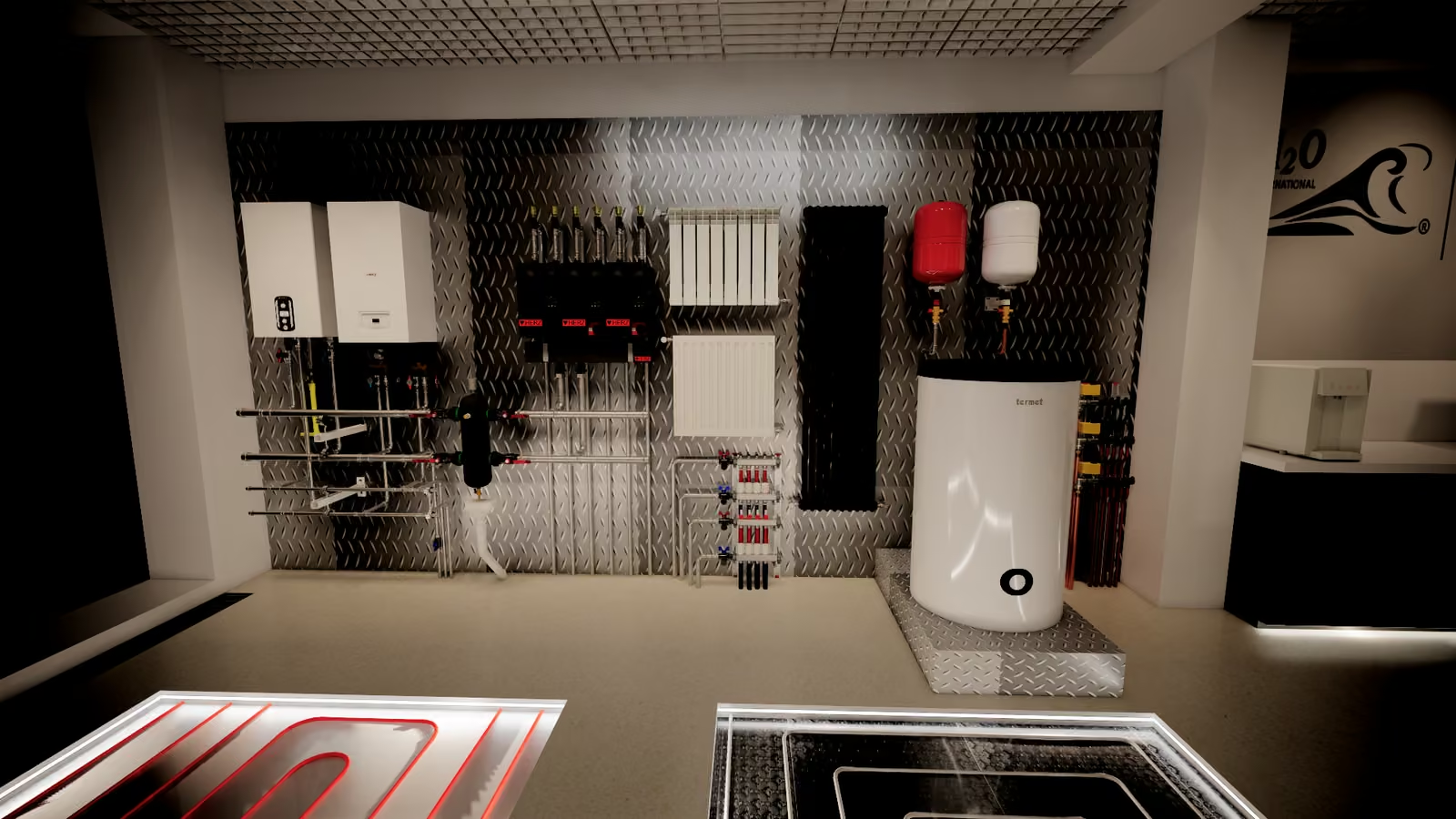
Next to it is the boiler wall in our showroom. Classes run right there: first the node on the drawing, then the same node by hand.
What comes with the modules
included- 01Water filtration
- 02Three months of free access to the new calculation software
- 03A day of questions and answers with Ziyodullo Abduqaxxarov
- 04Six months of support after the course
- 05A review of two of your own projects
Book a place on the next course
Leave a request — we will go through the format, the dates and the fee, and answer questions about the programme.